
KEY TAKEAWAYS FROM THE STATE OF THE UNION SPEECH.
Strasbourg, 16 September 2026.
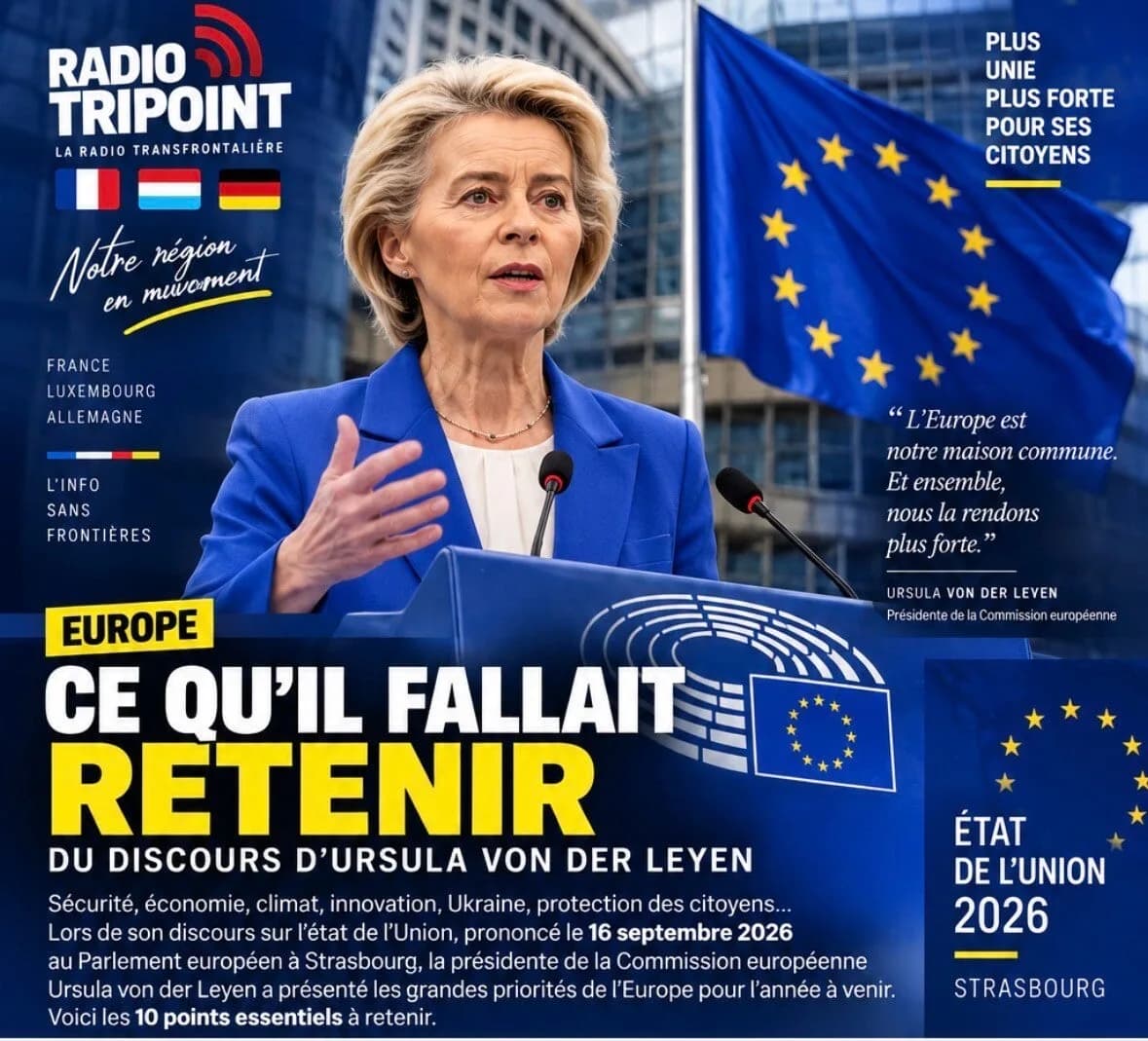
The 10 key points of Ursula von der Leyen's speech
Strasbourg, 16 September 2026. Before the European Parliament, the President of the European Commission, Ursula von der Leyen, delivered her annual State of the Union speech. For around an hour, she set out Europe's priorities for the coming year: economy, security, energy, climate, Ukraine, borders, artificial intelligence and the protection of children online.
Here are the ten key points.
1. A Europe that wants to act more for itself
The common thread of the speech: a more independent Europe, able to defend its own interests.
Ursula von der Leyen stressed in particular the need to reduce certain strategic dependencies, strengthen European industry and develop European capabilities in key sectors.
2. Competitiveness and simplification for businesses
The Commission wants to continue simplifying the single market.
The announcements include faster administrative procedures, measures for the banking sector and the creation of a European body for critical raw materials, which are needed for electric cars, batteries, semiconductors, clean technologies and defence, among other things.
The stated aim is also to complete the reform of the single market on the basis of the “One Europe, One Market” roadmap.
3. Housing, employment and social protection
The speech also addressed the everyday lives of Europeans.
Ursula von der Leyen announced a future Quality Jobs Act, focusing in particular on skills and the quality of work, as well as a European Care Deal to address the challenges of an ageing population.
Housing is also among Europe's priorities.
4. Europe wants to speed up on artificial intelligence
AI takes an important place in the European strategy.
Among other things, the Commission wants to step up cooperation with partners such as Canada and the United Kingdom and advance the use of AI in several sectors: health, transport, agriculture and food, industry, defence and space.
5. Climate, heat and water: adaptation becomes a priority
Climate change was also addressed from the angle of adaptation.
Among other things, the Commission is planning a European heat protection plan, a European water initiative and a new framework for climate resilience.
One tool is to identify in particular the European areas most exposed to climate risks.
6. A new European security architecture
This is one of the key points of the speech.
Ursula von der Leyen announced a new European security strategy as well as an emergency mechanism allowing Member States to coordinate their response to certain threats.
She also proposed the creation of a European Security Council, with planned cooperation with Canada, Norway, the United Kingdom and Ukraine, among others.
7. Ukraine remains a priority
The Commission wants to continue its support for Ukraine, particularly during the winter.
Ursula von der Leyen spoke about humanitarian and energy aid, but also about building a missile defence mechanism with Ukraine.
She also announced that pressure on Russia would be maintained through sanctions and that action would be taken against their circumvention.
8. Better-coordinated European borders
Migration and border protection took up a large part of the speech.
The Commission wants to continue implementing the European Pact on Migration and Asylum, strengthen Frontex and improve warning systems.
A new European framework for emergency deployments in certain exceptional situations at the external borders is also planned.
9. Better protecting children on social media
This is one of the announcements that could directly affect families.
The Commission wants to present the EU Kids Act, with an age-based approach to access to social media.
According to the proposals presented in the speech: no social media before the age of 13 and no personal accounts before the age of 15, with specific arrangements for young people aged 13 to 15.
The Commission also wants to tighten platforms' obligations to protect minors.
10. Canada could become the first “associate member” of the European Union
This is probably one of the most talked-about announcements of the speech.
In the presence of Canadian Prime Minister Mark Carney, Ursula von der Leyen proposed opening the way for Canada to become the first associate member of the European Union.
The aim would be in particular to strengthen economic, technological and industrial cooperation, as well as ties in the field of defence.
What next?
Beyond the announcements, the Strasbourg speech sets the direction for the coming months: competitiveness, security, strategic independence, climate change, social protection and the defence of European values.
Some of the measures announced still have to be presented as legislative proposals and go through the European Union's decision-making process. They are therefore not all rules that apply immediately.
The key point
A Europe that wants to become more competitive, more autonomous and more resilient to crises, while strengthening its social policy and the protection of its citizens.
Article based on the State of the Union speech delivered on 16 September 2026 and on official European Commission documents.