
Spiritual places in the Greater Region that you may not know.
The Greater Region is often described through its landscapes, villages, vineyards or cross-border history.
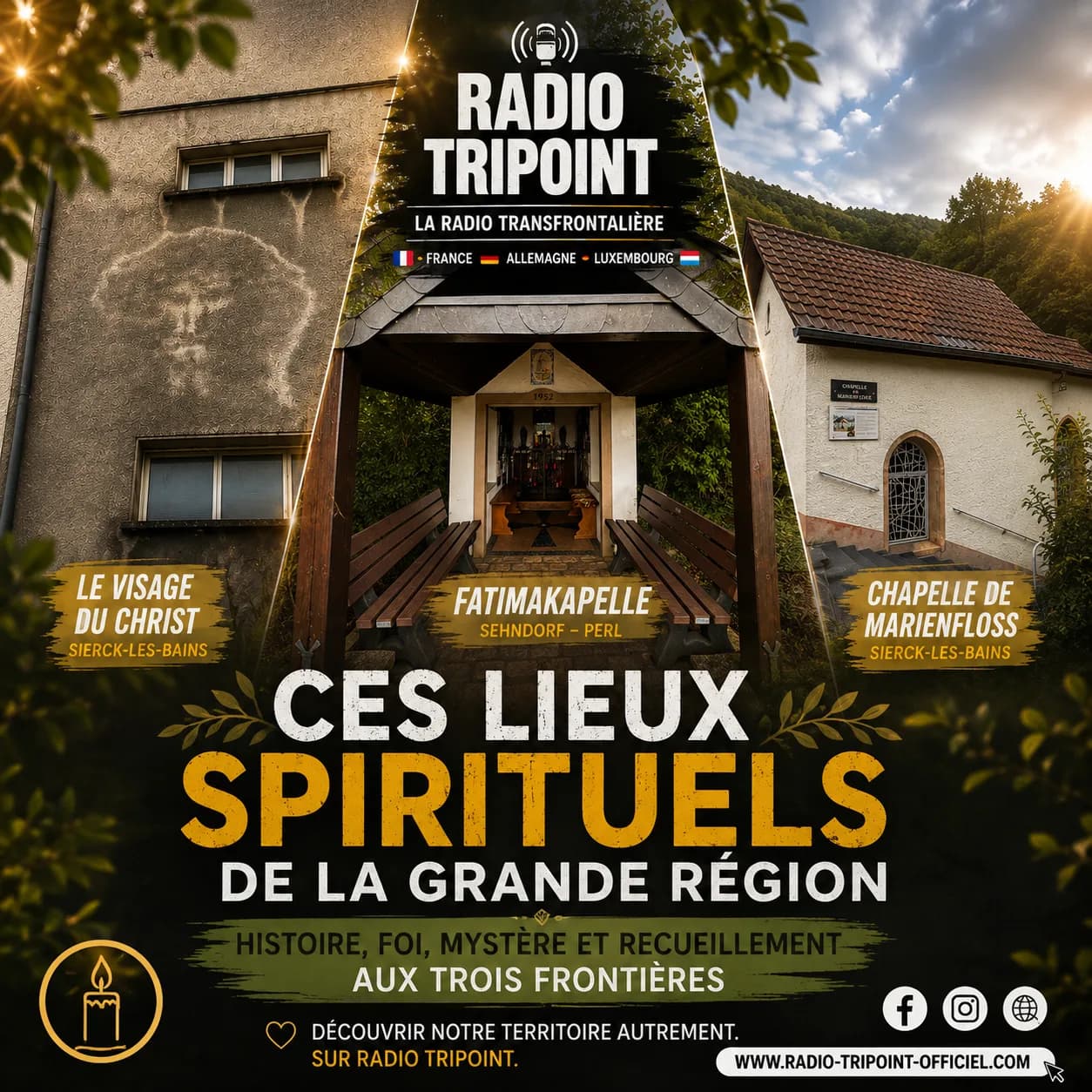
The Greater Region is often described through its landscapes, villages, vineyards or cross-border history. But it also has a particularly rich spiritual heritage — sometimes discreet, sometimes mysterious — that is worth rediscovering.
From small chapels in the middle of the vineyards to old abbeys, places of pilgrimage and stories that still intrigue people today: these places bear witness to a religious tradition that has deeply shaped our region.
In Perl-Sehndorf, in Germany, the little Fatima chapel is a fine example. Built in 1952 on the initiative of Josef Bladt, a resident of Sehndorf, it stands at the edge of the forest above the vineyards. A Way of the Cross leads up to the chapel, which is still a place of pilgrimage and reflection today. Every year on 15 August, among other events, a candlelight procession goes from the village to the chapel.
On the other side of the border, in Sierck-les-Bains, another place has intrigued people for decades: the famous Face of Christ. On the façade of a house, a shape appeared on the wall which some quickly saw as a human face and later associated with the face of Christ. Coincidence, natural phenomenon or a sign for those who see a spiritual dimension in it? Everyone can make up their own mind. The town has in fact included the site in its “Sierck-les-Bains, la spirituelle” trail.
Just a few steps away is the Marienfloss chapel, another important testimony to the area's religious history. The site has been linked to pilgrimage and spirituality for centuries. The town of Sierck-les-Bains presents it, among other things, as a place associated with the origins of the rosary. Today, Marienfloss still welcomes visitors, believers and people simply looking for a moment of calm and reflection.
But our region's spiritual history does not end in Sierck and Perl.
In Bouzonville, the former Sainte-Croix abbey is another remarkable place. According to the historical sources kept by the town, the abbey was founded at the beginning of the 11th century by Adalbert and Judith. Adalbert is said to have returned from a pilgrimage to the Holy Land with relics, including a fragment of the True Cross, which was kept in the abbey. The abbey was consecrated to the Holy Cross in 1033.
The history of this relic is itself eventful. In 1597, it is said to have been stolen by soldiers from the citadel of Metz and returned in 1616. An episode that further underlines the special character of Bouzonville's religious heritage.
And Bouzonville has other traces of this religious history, such as the Belle-Croix oratory or the Sainte-Croix chapel in Aidling, which once belonged to the abbey.
In this part of the Moselle, other, more modest chapels also dot the villages and paths. In Belmach, near Apach, the Saint-Antoine chapel recalls this long-standing religious presence in the Three Borders. In Merschweiller, the Notre-Dame de la Paix chapel has a special significance in a region marked by wars, borders and, today, reconciliation between peoples.
And on the Luxembourg side, the religious heritage of the Moselle valley is also part of this shared history. The churches and chapels of Schengen and the surrounding villages remind us that, long before European borders became more open, these communities already shared traditions, beliefs and stories.
So can we really speak of “energetic” places?
Of course, it cannot be scientifically proven that a chapel, a statue or an old place of pilgrimage has a particular energy. But there is another, more personal reality: that of how people feel.
The silence of a chapel in the middle of the forest. The light of a candle. An old statue. A vineyard landscape. A story passed down from generation to generation. Or simply a few minutes away from the noise of everyday life.
For some, it is a place of prayer. For others, a place steeped in history. For others still, simply a place where they feel good.
Perhaps that is exactly what makes these places so interesting.
Believers or not, practising or simply curious: everyone can discover them in their own way.
In France, Germany and Luxembourg, these chapels, shrines, abbeys and places of memory ultimately tell the same story: that of a region where cultures meet, traditions cross borders and religious heritage is still part of the landscape.
Radio Tripoint invites you to look at our Greater Region differently: through its well-known places, but also through all the small, sometimes forgotten spots that still tell a story.